New Castle County Dog Registration Information
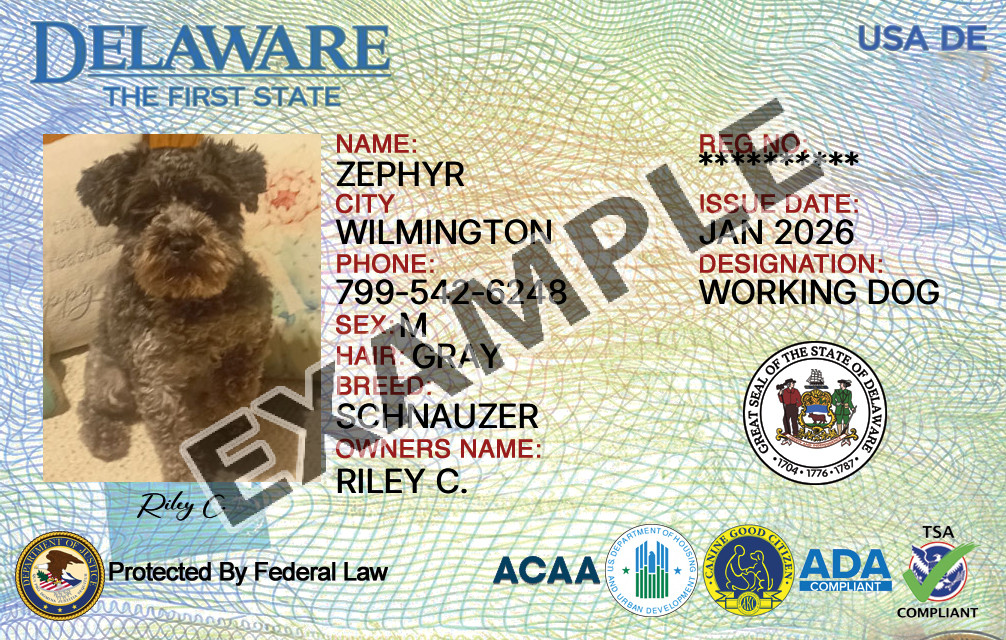
Service Dogs and Emotional Support Animals in New Castle, Delaware
If you’re searching for where do I register my dog in New Castle County, Delaware for my service dog or emotional support dog, the key thing to know is that most “registration” in this context is actually a dog license in New Castle County, Delaware (a local/state requirement tied to rabies vaccination and identification). Service dogs and emotional support animals (ESAs) generally follow the same licensing process as any other dog, even though their legal status and access rights are different.
- Dog licensing is handled through official animal welfare/animal services channels in Delaware and may be required regardless of whether your dog is a pet, a service dog, or an emotional support animal.
- There is no single universal federal “service dog registry” and no universal federal “ESA registry.”
- You should expect to show proof of rabies vaccination when obtaining or renewing a dog license.
Where to Register or License Your Dog in New Castle County, Delaware
The offices below are the most relevant official contacts for animal control dog license New Castle County, Delaware questions and dog licensing support. If you live inside an incorporated city or town (for example, Newark or Wilmington), there may be additional local rules for animal control enforcement; however, Delaware’s dog licensing is administered through the state’s animal welfare/animal services system.
Delaware Animal Services (Office of Animal Welfare, Delaware Division of Public Health)
Brandywine Valley SPCA (Copeland Center for Animal Welfare) — New Castle County
Overview of Dog Licensing in New Castle County, Delaware
What “registering your dog” usually means
In New Castle County, when people ask where to register a dog in New Castle County, Delaware, they usually mean obtaining a Delaware dog license and tag. A dog license helps connect a found dog to an owner and supports animal services administration. Licensing requirements are typically tied to public health goals such as rabies control and bite investigations.
County vs. city rules inside New Castle County
New Castle County includes multiple municipalities and unincorporated areas. Even when licensing is administered statewide, cities and towns may still have their own ordinances related to:
- Leash rules and “at large” enforcement
- Noise/nuisance complaints
- Number of animals allowed per household
- Reporting bites or dangerous dog concerns
What You Need Before Registering a Dog
Common requirements (what most residents are asked to provide)
While exact requirements can vary based on your dog’s status (spayed/neutered, age) and the licensing type (individual vs. kennel), most dog licensing requirements in New Castle County, Delaware revolve around vaccination proof and owner information.
- Rabies vaccination proof (often required to issue a license)
- Owner identification and current contact details
- Proof of residency may be requested depending on the transaction type
- Spay/neuter documentation (if a different fee category applies)
- Payment for the licensing fee (amount depends on license length/type)
Service dogs and ESAs: what’s different (and what isn’t)
For licensing purposes, many owners find that a service dog or emotional support dog is handled like any other dog: you still license the dog, and you still keep vaccination records current. What changes is not “registration,” but the dog’s legal protections and where the dog may be allowed with the handler (service dogs) or what housing accommodations may apply (ESAs).
Steps to Register or License a Dog in New Castle County, Delaware
Step 1: Confirm your local point of contact
Start with Delaware Animal Services (Office of Animal Welfare) for licensing guidance and the correct process for your address. If you prefer an in-person option in New Castle County, call the Brandywine Valley SPCA Copeland Center to confirm whether they currently process dog licenses and what you need to bring.
- If you are in an incorporated municipality, ask whether your city has any additional local requirements beyond the standard dog license.
- If you recently moved, ask how to update owner information tied to a license/tag.
Step 2: Gather documents
Have your rabies certificate ready (paper or digital), plus any spay/neuter documentation if applicable. Keep a copy for your records—especially if your dog is a service dog that accompanies you frequently.
Step 3: Apply and pay the licensing fee
Complete the licensing transaction through the official channel you confirmed by phone. Fees can vary by license type and duration. If you are unsure what category applies to you, ask before paying so your tag and records are correct.
Step 4: Keep your tag and records current
Once issued, place the license tag on your dog’s collar or harness as required. Renew on time and keep rabies vaccination current. If your contact information changes, update your record so a found dog can be returned quickly.
Service Dog Laws in New Castle County, Delaware
No universal federal service dog “registry”
Service dogs are not validated by a single nationwide federal registration database. In the U.S., service dog status generally depends on the dog being individually trained to do specific work or tasks for a person with a disability, and the handler meeting the legal definition of disability under applicable law.
Dog license vs. service dog status
A dog license in New Castle County, Delaware (or statewide license) is typically an animal control / public health identification requirement. Service dog status is a legal classification based on training and disability-related work. One does not replace the other.
- Licensing helps identify ownership and confirm public health compliance (like rabies vaccination).
- Service dog status relates to access rights for the handler in public settings where pets may not be allowed.
Emotional Support Animal Rules in New Castle County, Delaware
ESAs are not the same as service dogs
Emotional support animals provide comfort by their presence, but they are not necessarily trained to perform specific tasks. As a result, ESAs and service dogs are treated differently in many legal contexts.
Dog licensing still applies
If your dog is an emotional support dog, you generally still complete the standard licensing process. In other words, “ESA registration” is not the same thing as the official dog license process administered through the appropriate animal welfare/animal services office.
Dog License vs. Service Dog vs. Emotional Support Animal (ESA)
| Category | What it is | What you typically need | What it affects |
|---|---|---|---|
| Dog license | An official license/tag issued through government animal welfare/animal services administration for identification and compliance purposes. | Commonly includes proof of rabies vaccination, owner details, and payment of a licensing fee (plus spay/neuter proof if applicable). | Identification if your dog is lost; supports animal control/public health administration; may be required by law. |
| Service dog | A dog individually trained to do work or perform tasks for a person with a disability. | Training to perform specific disability-related tasks; handler meets disability definition under applicable law. Licensing and vaccines still typically apply as for any dog. | Public access rights for the handler in many settings where pets are not allowed (subject to lawful limits). |
| Emotional support animal (ESA) | An animal that provides emotional support/comfort by its presence; not necessarily task-trained. | Generally treated like a standard dog for licensing purposes; accommodation documentation may be relevant for housing situations. Rabies vaccination proof and licensing still typically apply. | Primarily relevant to certain housing accommodations; does not automatically provide the same broad public access as a service dog. |
Tip for residents: If your goal is “official registration” for a service dog or ESA, start with the standard dog licensing process, then separately maintain whatever documentation you need for housing or disability-related accommodations.
Frequently Asked Questions
Register A Dog In Other Delaware Counties
Select your county below to get started with your dog’s ID card. Requirements and license designs may vary by county, so choose your location to see the correct options and complete your pup’s registration.
